
WHY ARE PAINTING BIDS SO DIFFERENT? The Truth Behind Cheap vs. Expensive Painters in Utah
You’ve decided to give your home a serious face-lift. You’ve scrolled through countless design boards, argued with your spouse over three nearly identical shades of alabaster white, and finally called a few local painting contractors for estimates.
A few days later, the bids land in your inbox.
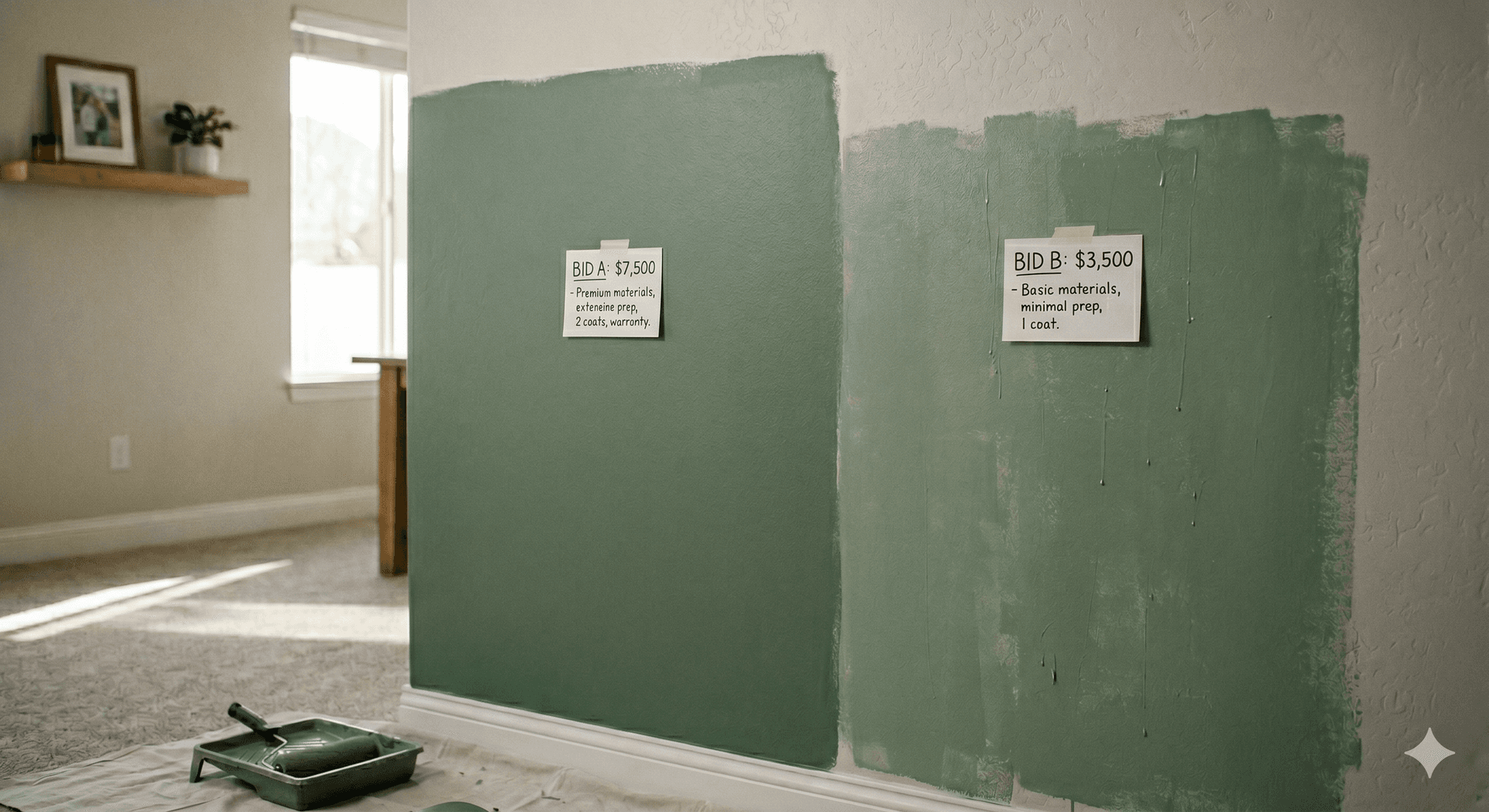
One quote sits at a comfortable, modest baseline. The other looks like a complete typo, coming in at more than double the price of the first.
Your jaw drops. It’s the exact same house. The same drywall. The same color. How on earth can two companies look at the identical project and come up with numbers that are oceans apart?
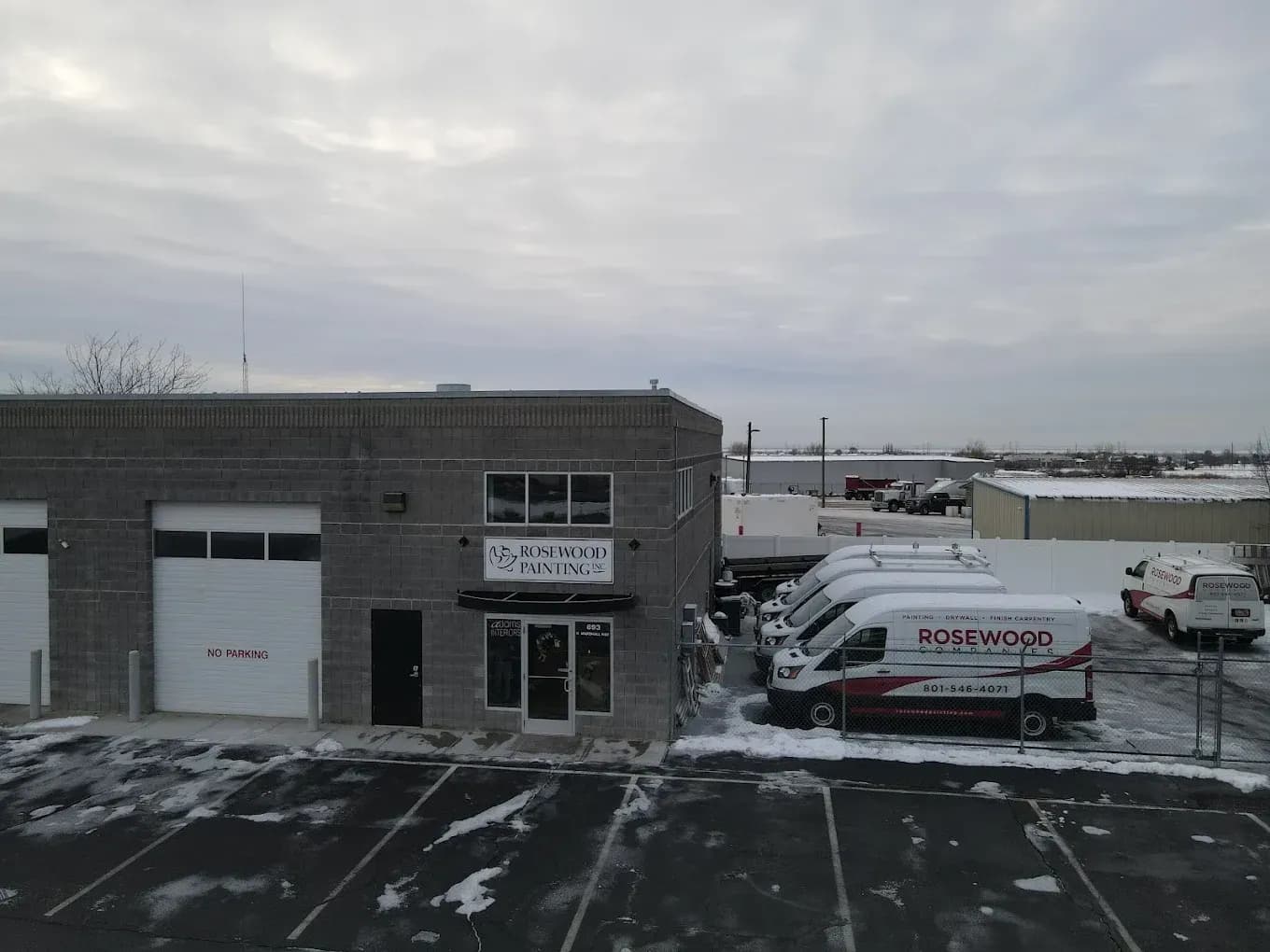
Because our team at Rosewood Painting and Remodeling, based out of Layton, tends to land on the higher end of that spectrum, we get asked this question all the time. It is a completely valid concern. If you are looking at a massive price gap on a home improvement project, you deserve to know exactly why it exists.
Painting is a unique trade. It’s an industry where a solo operator with a ladder and a dented tailgate can compete for the exact same Google real estate as a multi-crew corporation with a physical headquarters. As brothers running a business in a grit-and-muscle industry, we believe in radical, zero-fluff honesty. The truth is, both options exist for a reason, and the "expensive" choice isn't always the right one for every homeowner.
Let’s take an unbiased, completely transparent look at the mechanics of a cheap paint job versus a premium one so you can make the right call for your home, your family, and your wallet.
WHAT WILL WE COVER IN THIS GUIDE
To help you navigate these confusing estimates, we have broken down this guide into the exact financial, legal, and technical factors driving contractor costs up and down:
- When a Low Bid Makes Sense: The specific scenarios when choosing a budget painter is actually the right consumer call.
- The Math Behind the Bids: How floor-space guesswork compares to precision, line-item estimating.
- The Legal Safety Net: What you are risking regarding licensing, general liability, and workers' compensation.
- The Invisible Labor: Breaking down advanced preparation techniques like micro-spackling and specialized light checks.
- The Quick-Look Matrix: A direct side-by-side comparison chart for fast scannability.
- The Next Steps: The exact vetting questions to ask any contractor before signing a contract.
WHEN DOES A CHEAP PAINTING BID MAKE PERFECT SENSE?
(The Pros of Low-Cost Painters)
Let's clear the air immediately: a lower price tag does not automatically mean a contractor is a scammer or out to get you. There are plenty of scenarios where hiring a low-cost, cash-on-the-barrel painter is actually the smartest decision for your budget.
1. The Direct Overhead Advantage
Lower bids don't always mean malicious corner-cutting. Sometimes, it's just basic economics. A solo painter who handles his own estimates, schedules his own work, and swings the brush himself has virtually zero overhead. He doesn't pay for administrative staff, digital project tracking, or a commercial shop facility. Because his operational costs are microscopic, he can pass those direct savings on to you.
2. When "Good Enough" Is the Right Goal
Every project has a different end game and every person has different priorities. You may consider a lower-priced option if:
- You're Working with a Strict or Tight Budget: If minimizing immediate, upfront out-of-pocket expenses is your primary constraint, a low bid keeps cash in your pocket right now.
- You're Not Concerned with Paint Quality and Longevity: If you plan on tearing down these exact walls, altering your home's layout, or starting major structural renovations in a year or two, investing in a finish built to survive fifteen years may not necessary. A budget-friendly refresh gives you a clean look for the interim without paying for long-term performance you won't use.
- You're Comfortable Taking on Some Risk: If you're comfortable managing future touch-ups without a warranty and accepting the potential risks associated with hiring an uninsured contractor, a lower-cost bid may be the right choice for your project.
- Your Project Timeline Is Flexible: A lower bid can be a great option if you aren't on a rigid schedule and have plenty of breathing room. Smaller or lower-cost teams often operate with fewer crew members, meaning they don't always have the extra manpower to absorb sudden project changes, weather emergencies, or multiple overlapping jobs without some stalls or delays mid-way through. If you don't mind a fluid completion date, this setup can save you money.
- You're Painting a Low-Visibility Area: If you are painting a dark basement utility room, a mechanical closet, or a basic backyard storage shed where cosmetics don't matter, paying for museum-grade drywall precision is likely overkill. A simple, no-frills paint application keeps costs baseline where perfection isn't required.
BIDDING SCIENCE: The "Guesswork Estimate" vs. Detailed Line-Item Proposals
One of the most immediate points of divergence between cheap and expensive painters happens before a single drop of paint ever hits a tray. It’s how they calculate your price.
1. The Floor Space Illusion
Most low-cost estimates are born from a quick walkthrough and a heavy dose of intuition. A painter walks into your living room, glances up, multiplies your floor square footage by an arbitrary number in his head, and scribbles down a flat rate.
The problem? You don't paint floors; you paint walls, trim, doors, and ceilings. Floor square footage tells a contractor absolutely nothing about the actual architecture of the room. It doesn't account for 12-foot vaulted ceilings, intricate crown molding, or a room packed with five doors and three multi-pane windows.
When a contractor guesses their numbers, they are rolling the dice. If they realize mid-project that they underbid the job and are actively losing money, one of three things inevitably happens to protect their bottom line:
- The Surprise Change Order: Suddenly, you're hit with unexpected fees halfway through the project because "the trim took longer than expected."
- The Shifting Deadline: Your two-day job stretches into two weeks because the painter has to jump over to a more profitable project to keep his head above water.
- The Disappearing Act: The contractor stops answering phone calls altogether, leaving your home half-taped, dusty, and completely disrupted.
2. The Fixed-Cost Standard
A premium bidding process leaves zero room for guesswork. When you receive a high-end proposal, every single cost is itemized using laser-measured wall heights, exact casing counts, substrate conditions, and surface-specific difficulty ratings.
If you want to see what a transparent, professional project pipeline looks like, take a look at our recent projects page to see the level of consistency this method produces. The price you see on a detailed contract is locked before the project starts, shielding you entirely from mid-job financial friction.
THE LEGAL REALITY OF HOME RENOVATION
Consider the worst-case scenarios that happen on residential job sites every single week:
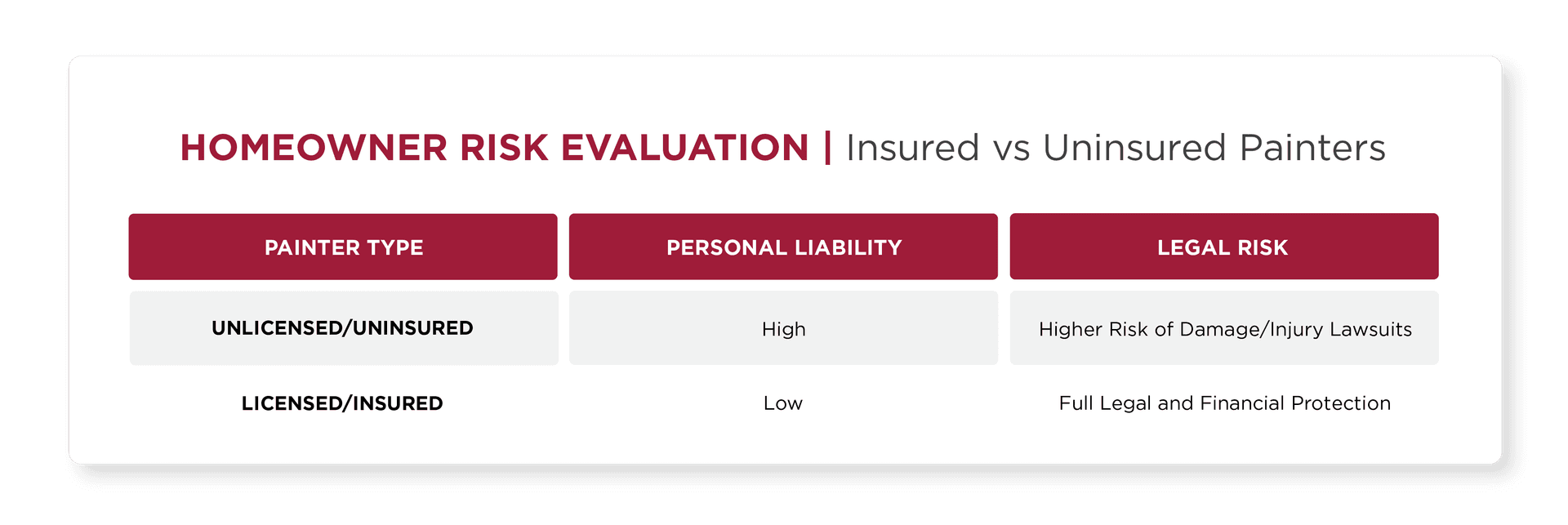
Property Damage: A painter is moving an aluminum extension ladder through your home, loses his footing, and smashes the ladder straight through a newly installed window unit. If that contractor doesn't carry general liability insurance, guess who is left paying for the replacement? You are.
The Workplace Injury Nightmare: Painting requires working at heights. For example, here in the Wasatch Front, we have plenty of gorgeous homes with towering entryways, grand staircases, and high-set windows in places like Layton, Ogden, Morgan, and across Davis and Weber County. If an independent painter or an uninsured sub-contractor falls off a scaffold on your property and doesn't carry workers' compensation insurance, your personal homeowner's insurance policy becomes the primary target for medical bills and lost wages.
When you pay a premium for an established company, a significant portion of that investment goes directly toward your legal protection. A true professional operates with a legitimate brick-and-mortar footprint, maintains active licensing with the state, carries robust general liability coverage, and protects every technician with workers' compensation.
Furthermore, a company that stands behind its craftsmanship provides an ironclad, written warranty—not a verbal "call me if it peels" promise. If a warranty issue arises, an established company has the infrastructure, administrative staff, and financial stability to actually show up and fix it.
INSIDE THE PREP WORK: Explaining "Brush and Roll" vs. Premium Technical Precision
There is a golden rule in the trades: Painting is 90% preparation and 10% application. Anyone can open a can of paint and slap it on a wall, but a flawless, durable finish is earned entirely through meticulous, exhausting labor before a drop of color ever touches the surface.
This is where the massive hours-and-labor gap between an entry-level bid and a premium bid becomes crystal clear. A budget painter is forced to speed through the prep phase because they simply do not have the budgeted hours to slow down. A premium painter builds meticulous, multi-step preparation directly into the scope of work.
To understand what you are actually paying for, you need to understand what these technical prep terms mean in practice:
What Is Micro-Spackling?
Standard spackling involves filling the obvious nail holes left behind by old picture frames. Micro-spackling is a completely different level of detail. A technician systematically inspects every square inch of your drywall under intense scrutiny, identifying microscopic dings, surface scuffs, hair-line settling cracks, and old texture inconsistencies. These tiny imperfections are filled with specialized patching compounds, sanded perfectly flush, and spot-primed so they don’t absorb paint differently than the rest of the wall (a flaw known as "flashing").
The Specialized Light Check
Drywall imperfections love to hide under standard residential overhead lighting. You won't notice them until the afternoon sun hits the wall at a specific angle three weeks after the painters have cashed your check.
To prevent this, premium crews carry high-lumen, handheld directional lighting across every square foot of the wall during the sanding process. By casting a harsh, raking light parallel to the wall surface, any hidden shadow, dimple, scratch, or ridge is instantly exposed and corrected before the topcoat is applied.
Application Methods: Traditional vs. Advanced Spraying
A budget painter will almost exclusively use a traditional brush and roller for everything. While a roller is great for adding texture to a standard wall, it leaves behind a distinct stipple pattern and visible brush marks on smooth woodwork.
A premium painting company invests heavily in advanced spraying technology. We spray 95% of our interior and exterior projects because it allows us to lay down paint with surgical precision, creating a mirror-smooth, factory-grade finish. We only allow our crews to use a brush on specific, high-end architectural coatings that are chemically engineered to flow and self-level perfectly.
The Shop Facility Advantage
If you are updating intricate crown molding, trim packages, or cabinet doors, where does that work take place? A low-cost painter will typically set up a makeshift paint station right in your driveway, garage, or living room. This exposes your family to heavy fumes and leaves your freshly wet paint vulnerable to dust, pet hair, and airborne outdoor debris.
An established professional contractor maintains a dedicated, climate-controlled shop facility. We pull your removable woodwork and cabinet doors out of your living space and transport them to our shop. This keeps the mess out of your home, protects your indoor air quality, and allows our team to cure your finishes under perfect, dust-free, factory-controlled conditions.
To learn more about how we apply these exact industrial standards to every home we enter, explore our comprehensive painting services page.
THE CONTRACTOR-GRADE PAINT BAIT-AND-SWITCH
Here is a major industry blind spot that catches thousands of smart homeowners off guard: The brand name on the bucket does not guarantee the quality of the paint inside.
Many budget painters will point to their proposals and proudly say, "Look, I only use Sherwin-Williams paint." What they aren't telling you is that every single major paint manufacturer produces a massive hierarchy of product lines, ranging from cheap, low-tier "contractor-grade" mud to ultra-premium resins.
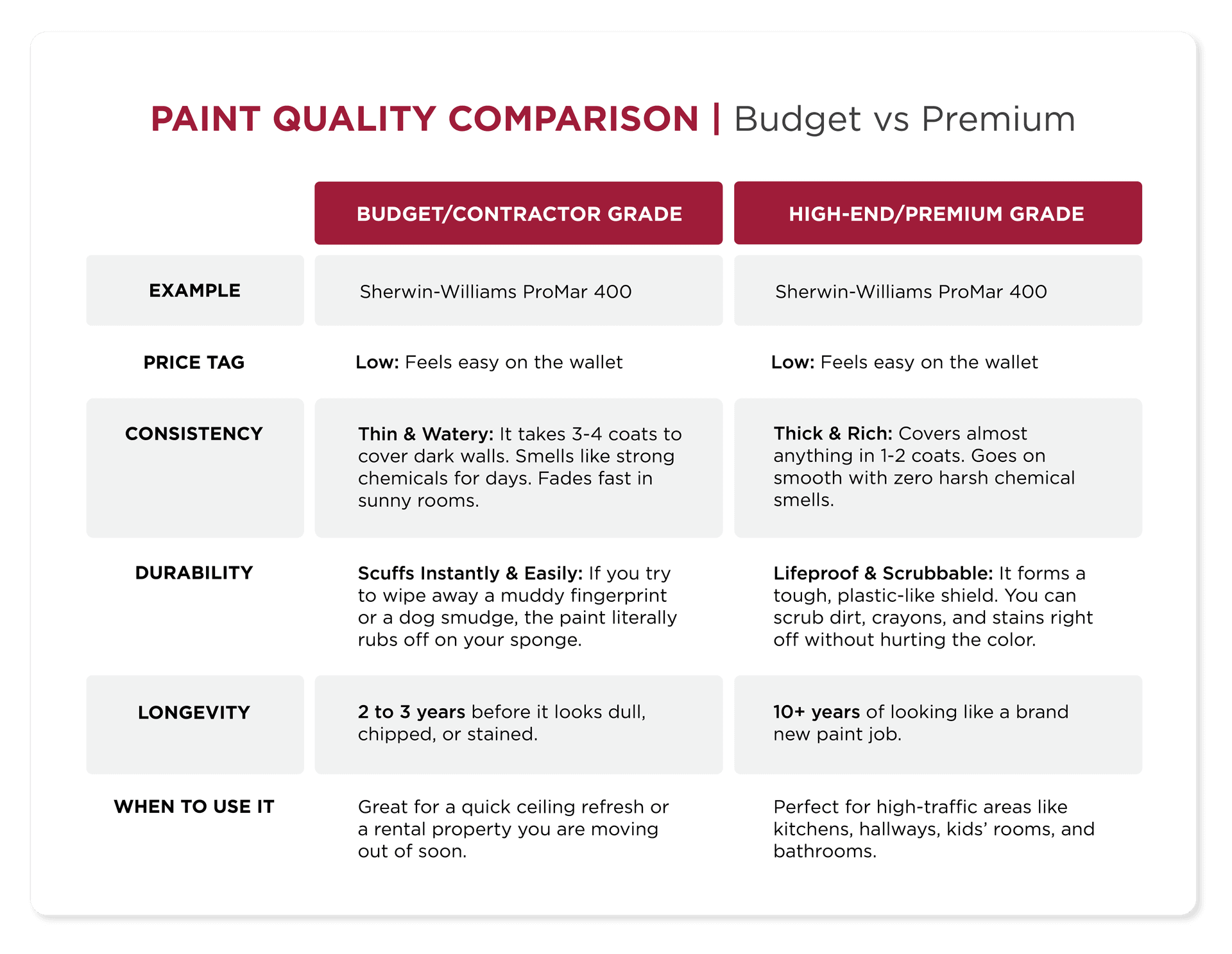
Cheap paint is cheap for a reason: it lacks high-quality resins and titanium dioxide solids. It requires more coats to cover a wall, fades rapidly when exposed to the elements, and stains permanently the first time a pet scuffs past it or a child throws a toy near it.
At Rosewood, we completely phased out lower-tier contractor paints years ago. We learned that using cheap materials was a massive disservice to our clients. We migrated our standard exterior and interior operations entirely to top-tier lines like Sherwin-Williams Emerald.
The result of that shift? Our company-wide warranty callback rate instantly dropped to under 0.5%. Less than half a percent of our projects ever require a touch-up. By investing in premium raw materials upfront, we ensure that once our trucks leave your driveway, your home stays beautiful for a decade.
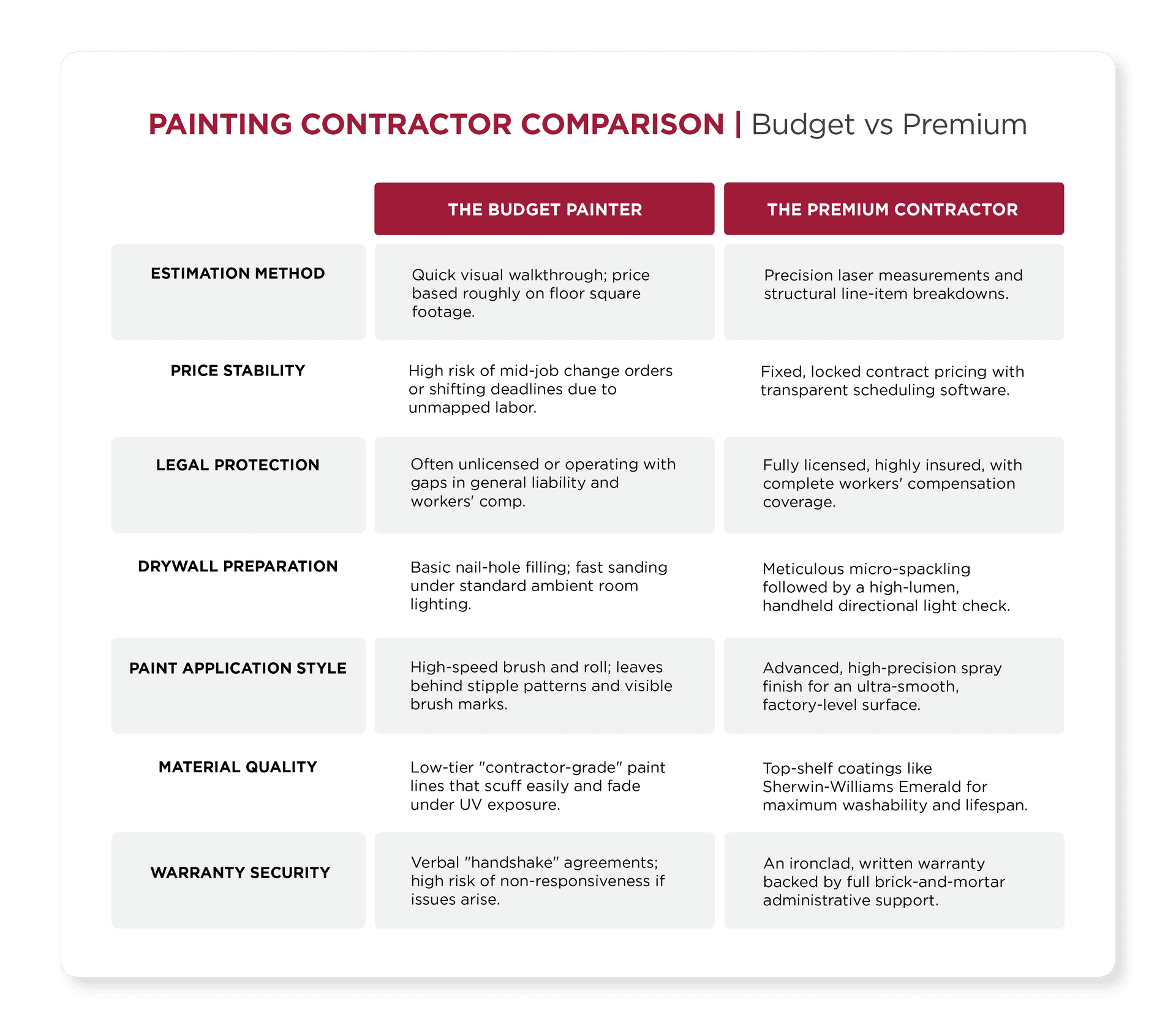
SUMMARY: Cheap vs Expensive Painters at a Glance
To cut through the noise, let's look at a direct, side-by-side comparison of what you are actually buying at these two distinct price tiers:
HOW TO CHOOSE THE RIGHT BID FOR YOUR HOME REMODELING PROJECT
At the end of the day, the choice between these two tiers of bids boils down to your personal goals, your threshold for risk, and how you view the long-term equity of your home.
If you are painting a temporary space, working on a tight short-term budget, or simply don't mind a few visible brush marks or texturing flaws, the lower-priced option can be a perfectly viable path forward.
However, if your home is your primary investment, if you value seamless communication, and if you want a finish that will withstand a decade of real life without fading or peeling, the premium route is worth every single penny. Remember: fixing a failed, rushed paint job requires sanding down drips, scraping away peeling cheap paint, and re-priming the entire structure. That process actually costs twice as much as doing it right the first time.
Before you sign on the dotted line with any contractor, protect your home by asking the low-bid option these three specific vetting questions:
- "Can you provide a copy of your active state license and a current certificate of insurance showing both general liability and workers' compensation coverage?"
- "What specific product line and grade of paint are you writing into this proposal, and is this a guaranteed flat-rate bid or will there be change orders for trim and prep hours?"
- "Walk me through your sanding and preparation process—are you using directional light checks, and what step do you take to guarantee a completely smooth finish on our doors and trim packages?"
Their answers will instantly tell you whether you are getting a genuinely good deal, or if you are simply paying for cut corners.
If you are ready to experience a remodeling process built entirely on premium products, ironclad safety nets, and radical transparency, we are here to help. Head over to our estimate request page to schedule a detailed, laser-measured evaluation with our team today.
ANSWERS TO HIGHLY SEARCHED BUYERS QUESTIONS (FAQs)
Is an expensive painter always better than a cheap one?
Not necessarily. An "expensive" price tag is only better if it directly pays for things that protect your home equity, like line-item laser measurements, robust general liability insurance, experienced painters earning true living wages, and high-tier coatings like Sherwin-Williams Emerald. If a company charges premium prices but still rushes their drywall preparation or cuts corners on insurance safety nets, you are paying a luxury price for budget craftsmanship. Always verify what specific processes and protection policies are attached to that higher price tag.
Why do painting estimates vary by thousands of dollars for the same house?
The massive price spreads you see on painting estimates are determined entirely by how much invisible labor and legal safety netting a company includes in their quote. Low-cost bids often pass direct savings onto you by skimping on thorough drywall preparation (like skipping micro-spackling and raking light checks), using lower-tier contractor-grade paint lines, or carrying zero general liability and workers' compensation insurance. High-end bids are built around fixed, locked contract pricing, comprehensive structural protections, and highly precise spraying technology to ensure a lasting finish.
How can I tell if a low-cost painting bid is safe to sign?
A budget estimate can be a great tool for temporary refreshes or rental properties, but you must ensure they aren't offloading massive legal liability onto your home. Before signing a contract with any budget contractor, run through a strict home service verification protocol: verify their active business standing on the Utah Division of Professional Licensing (DOPL) database, request a direct certificate of insurance (COI) sent from their insurance broker confirming both general liability and workers' comp coverage, and ensure the proposal lists the exact product line being used rather than a generic brand name.
What should be included in a professional painting contract?
A comprehensive home improvement contract should leave absolutely zero room for guesswork or mid-job negotiations. A premium painting contract must explicitly state a fixed total price alongside a detailed, line-item breakdown of every surface being touched—including exact counts of casings, doors, windows, and wall heights. It should clearly define the exact manufacturer line being applied, specify a concrete timeline for completion, detail the scope of clean-up and property protection, and outline an explicit, multi-year craftsmanship warranty policy in writing.
Check Out Our Reviews

Mitch and the Rosewood Team are true pros! Outstanding quality with great communication and attention to their clients’ budget. They recently repaired an exterior door for me that I was certain would need replacing. They did excellent work and saved me several thousand dollars compared to what a full replacement would have cost.
Mitch and his group do an amazing job at window replacement. New windows help with home efficency, noise, and so many other things. If you are looking for new windows, I would give them a call, it is well worth the time to talk to them about how they can help you.
The team from Rosewood did an amazing job installing this set of doors to complete a project of turning this room into my wife’s home office. They are kind, competent, and very skilled! They did a great job installing and putting the finishing touches to these doors.
All around a top notch and professional contractors. I had a great experience with their customer service in getting a quote and set up for a cabinet painting job at my home. The team lead for the project Ben and his crew member Drake were very professional and friendly. They did a phenomenal job on our cabinets and cleaned up everything thoroughly. Couldn’t have asked for a better team!
Great company with good communication and quality work. I have used them for two projects so far and satisfied with both. Pricing is reasonable and they are flexible to adjust the bid as needs require. Highly recommended.




Contact Us
Mon-Fri: 8:00am-5:00pm
Sat-Sun: Closed